

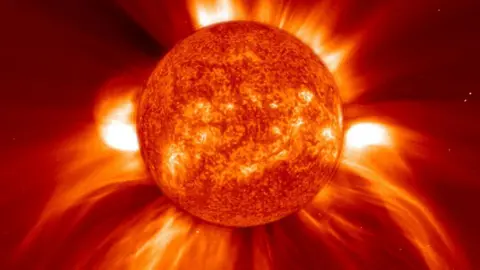
Regarding India's first solar observatory, the year 2026 will be truly unique.
It's the first time the spacecraft – which was placed into space recently – can watch our star during its maximum activity cycle.
As per research, it comes roughly once every 11 years when the Sun's magnetic poles flip – the Earth equivalent could be the planet's poles changing places.
This period of great turbulence. It sees our star transition from calm to stormy and is marked by a significant rise in the frequency of solar eruptions and massive solar flares – massive bubbles of plasma that blow out of the Sun's outermost layer.
Made up of charged particles, a coronal mass ejection can weigh up to a trillion kilograms and reach velocities of up to 3,000km per second. It can travel in any direction, including towards our planet. At top speed, the journey takes a CME 15 hours to cover the vast distance Earth-Sun distance.
"In the normal or low-activity times, the Sun emits two to three CMEs daily," explains a leading scientist. "In 2026, we expect there will be 10 or more each day."
Researching coronal mass ejections ranks among the key research goals for the Indian first solar observatory. One, as these eruptions provide an opportunity to study the star in the center of our planetary system, and secondly, because activities that take place on the Sun endanger systems on our planet and in space.

Effects on Our Planet and Orbital Systems
CMEs seldom present immediate danger to human life, but they do affect life on Earth through generating geomagnetic storms affecting conditions in near space, where about thousands of spacecraft, including many from India, orbit.
"The most beautiful manifestations of a CME include northern lights, which are a clear example that solar particles from our star journey to Earth," the scientist clarifies.
"But they can also cause electronic systems aboard spacecraft malfunction, knock down electrical networks and affect meteorological and telecom spacecraft."
Historical Solar Events
- The most powerful solar event ever recorded occurred during the 1859 solar superstorm which knocked out telegraph lines across the globe
- During 1989, a part of Quebec's power grid failed, leaving millions in darkness for hours
- In November 2015, solar storms disrupted air traffic control, leading to disruption in Sweden and some other European airports
- Recently in 2022, a CME caused 38 commercial satellites being lost
With capability to see what happens in the solar atmosphere and spot a solar storm or solar eruption as it happens, record its temperature at the source and track its trajectory, this serves as a forewarning to switch off electrical systems and satellites redirecting them out of harm's way.
Aditya-L1's Special Capability
While other space observatories watching the Sun, India's spacecraft has an advantage compared to rivals when it comes to watching the corona.
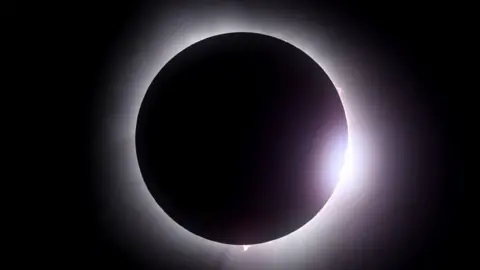
"Aditya-L1's coronagraph has perfect dimensions enabling it to effectively simulate the Moon, fully covering the solar disk permitting continuous observation of nearly the entire solar atmosphere around the clock, 365 days a year, including during eclipses and occultations," notes the researcher.
Essentially, the coronagraph functions as a synthetic eclipse, blocking the solar glare allowing researchers constantly study the dim solar atmosphere – something natural eclipses provide only during specific moments.
Moreover, it's unique capable of examining solar events in visible light, letting it determine eruption heat and thermal output – crucial data that show how strong of an eruption when traveling toward Earth.
Preparation for Peak Period
In preparation for the upcoming peak solar activity period, researchers worked together to study information obtained from one of the largest CMEs recorded by the mission has recorded until now.
It originated on 13 September 2024 during early hours. The eruption's weight was 270 million tonnes – for comparison that struck the ship weighed much less.
Initially, its temperature reached extreme levels and the energy content was equivalent to 2.2 million megatons of explosives – in comparison nuclear weapons on Hiroshima and Nagasaki were 15 kilotons in scale each.
Even though these figures seem incredibly large, the expert describes it as a "medium-sized" one.
The asteroid that eliminated the dinosaurs on Earth was 100 million megatons and during the Sun's maximum activity cycle, we could see CMEs with energy content matching even more than that.
"I consider this eruption we analyzed happened during periods of typical solar activity. Now this sets the benchmark for future comparison assessing what to expect when the maximum activity cycle arrives," he says.
"The insights gained will help us work out the countermeasures to implement safeguarding satellites in orbit. They will also help us gain a better understanding of our space environment," he concludes.


